Trans Influenced Rock: The 1980s, 1990s, and Beyond…
“Dude looks like a lady…” –– Aerosmith
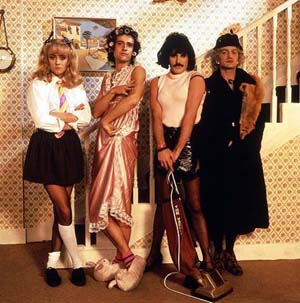
Queen dressed for their I Want To Be Free video.
The early 1980s saw massive change in the music industry. Many acts from the 1970s found their record sales dwindling, and public interest in music had dropped to dangerously low levels. Children were now spending their quarters on video games instead of music, and it became apparent that there needed to be change in the industry. Executives anxiously waited for ‘the next big thing’…
Their prayers were answered with the onset of the British “New Wave.” Dozens of bands with tuneful pop songs and highly fashion-conscious images made their way onto the North American record charts. Also, the relatively new medium of the music video evolved from being a novelty to a legitimate marketing tool. Image became as important, if not more so, as the music. Artists with varying degrees of trans in their image reaped the benefits of the new interest in video. Eyeliner and lip gloss once again became de rigueur for the discerning rock star. Duran Duran, megastars of the period, all wore makeup, and generally favored light-colored pastel clothing. Though criticized and ridiculed by some for their image, they nonetheless packed arenas full of screaming teenaged girls, graced the covers of countless magazines, and sold millions of records in the process.
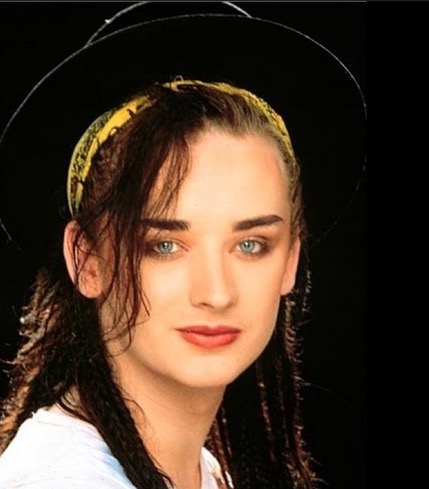
’80s Boy George.
While bands like Duran Duran walked a fine line of androgyny, the New Wave gave pop one of its first truly overt transgender stars. George O’Dowd, better known as Boy George, and his band Culture Club became huge stars in North America and across the globe despite, and perhaps partially because of, his openly transgendered look. Though standing well over 6 feet, Boy George presented a completely feminine image. He wore his hair long, in a feminine style, full face makeup, and dressed in loose flowing clothing. Even his singing voice was soft, and female. He became an instant hit with the media, and the band reaped the rewards of pop stardom.
(Unfortunately, with such quick success often comes an equally quick descent, and Boy George found himself in trouble with drugs, the law, and band-less by the late ‘80s. Thankfully he did manage to recuperate, and went on to sing the theme song of Neil Jordan’s transgendered blockbuster film The Crying Game.)
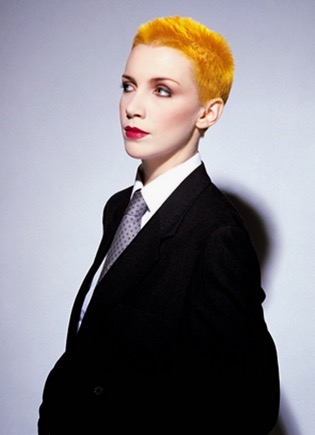
Annie Lennox
At the opposite end of the gender spectrum from Boy George was Annie Lennox with Eurythmics. Though males exploiting feminine traits in rock music was nothing new, the idea of a woman intentionally presenting a strong masculine image was a relatively new one. Lennox and her harsh, short cropped hair, man-style grey suits, and leather gloves was as far from ‘sweet’ or ‘feminine’ as one could imagine. Eurythmics scored immediate success with the single and accompanying video for Sweet Dreams (Are Made of This). As the decade progressed Lennox’s image softened, leaving behind the ultra-butch look that launched the band’s success, eventually abandoning the look altogether. Still, Sweet Dreams is the song remembered for starting her career, and the image she presented is inevitably intermingled with the song.
By the mid-1980s the success of trans images in rock had made it all the way to the longtime bastion of over-stated masculinity, Heavy Metal. Twisted Sister (whose initials, ironically enough, are “TS”), with lead singer Dee Snyder, contrasted high-testosterone song themes like We’re Not Gonna Take It with caricatured female facial makeup. Other bands soon found lip gloss, eyeliner, and blush infiltrating their images. Faster Pussycat, Motley Crüe, White Lion, and countless other spinoff bands inadvertently formed their own sub-genre, Glam Metal. Even heavy metal legends Kiss traded their infamous theatrical makeup for more subtle looks and flowing neon clothes.